Search This Blog

Saturday, July 26

Organic Pest Control

You have been attempting organic production. Land preparation and establishment of crops has been a success with Compost. In the process of scouting, you observe one caterpillar. Then two. And overnight you have two hundred on one plant! Abandoning your attempt at organic farming seems to be the follow-up activity in the sequence of organic farming practices. But wait, there is hope yet! At a training workshop held on Thursday July 24, 2014, the use of plants for biological control of pests was demonstrated.
L-R: Adelfa (red), Adelfa (pink), Neem

The plants selected for today's demonstration were:
  1. OLEANDER: A fixture of the home garden, this plant has great POTENTial for organic pest control. You can identify the plant by the dull green, slender pointed leaves with clusters of flowers at the end of the branches. The flowers range in colour from white through cream, pink rose and red. Participants were cautioned of the toxicity of the plant. In handling the plant, one should not eat, drink nor smoke. So poisonous is this plant, that even food cooked on the wood is poisoned. Does this leave any doubt in your mind that the Oleander can be effective in pest control? It can be used to control ants, flies, caterpillars and other insects. Other names by which this shrub is known includes Adelfa, Rose Bay and Rosa Fancesca.
  2. NEEM: The use of neem as a biological pesticide is known far and wide due to its commercialisation. The seeds are a more concentrated source of the pesticidal ingredient than the leaves. The seeds (kernels) are used to make neem oil. Neem is used in the control of pests such as beetles, termites, scale insects, mealy bugs and aphids.
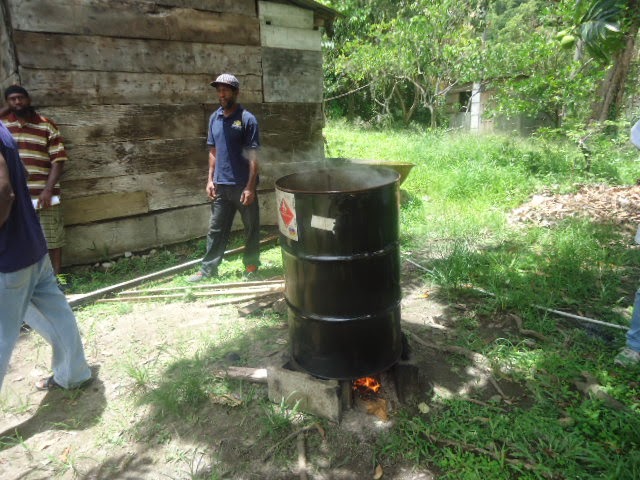
    It's bubbling and it's not soup
METHOD: 
  1. Crush and boil leaves, seeds or bark for 30 minutes
  2. Let cool 
  3. Pour into spray can
  4. Add soap mixture (Grate one bar of blue soap and add to 5 gallons of water; Use 500mL to 1 spray can)
  5. Spray!
POINTS TO NOTE:
  • The Oleander can also be crushed and SOAKED  for 30 minutes (See Step 1). It is more poisonous when boiled than soaked.
  • Neem is most effective under humid conditions or when the insect and the plants are damp.
  • Cover the container when boiling (regardless of plant selection) to prevent the entry of light as light reduces the potency. The cooled extraction should also not be be exposed to sunlight.
  • The boiled contents are only good for 48 hours.
  • After mixing with soap, the solution is only effective for 8 hours.
This can be tailored to both large scale production and production for home use. For home use, I would recommend Adelfa as the better option as it is widely available and can be soaked instead of going through the boiling method.

Saturday, July 19

Farmer Field School Open Day

"A farmer is a person outstanding in their field". Get the double entendre?

At Farmer Field School, farmers perform outstandingly at a learning program which is very practical and participatory. What is Farmer Field School? The following video provides an overview of the program with the description of the project, teaching methodology and participant feedback:


On Wednesday, July 16, 2014, an Open Day was held for the the Farmer Field School for the region of Choiseul/Soufriere. Field School for this region is conducted on the farm holding of Mr. Compton at River Doree, Choiseul. The program which is currently funded by the Taiwan International Cooperation and Development Fund also benefits from technical support of the Taiwan Technical Mission. The sessions are also facilitated by the Ministry of Agriculture Extension Services. In attendance were representatives from the Embassy of Taiwan, Taiwan Technical Mission, Ministry of Agriculture, Inter-American Institute for Cooperation on Agriculture (IICA), Caribbean Agricultural Research and Development Institute (CARDI), Hotels and Ministry of Social Transformation.

The event was organised with a presentation on Good Agricultural Practices (GAPs) in the production of watermelon and corn-these were the two crops grown by the Field School participants. These GAPs presented ranged from production to post-harvest to marketing activities.

Audience to Mr. Pilgrim's (CARDI) presentation

Afterwards, the group was taken on a tour of the field cultivated by the Field School trainees. The varieties of watermelon planted were the Empire No. 2 and Dark Belle. The corn varieties cultivated were the White Pearl and America H5. 
Intercropped corn and watermelon

After the walk in the afternoon sun, we were refreshed with the Watermelon Tasting segment of the activity. The fruit of the labour of the Field School trainees were on display whole and sliced for the enjoyment of the visitors. Following which there was a Question and Answer Segment.
Taste test: Which variety do you prefer?
Congratulations to the trainees who will be graduating from the Farmer Field School at the end of the month on their achievement!

Wednesday, June 25

Fruit Feature: Canistel


In this account of agventures (adVENTURES in AGgriculture), I can provide no justifiable explanation why this my first encounter with this fruit. I have never seen it sold in local farmers' market. Sadly, this is not a familiar fixture of home gardens. Maybe, others are in the same predicament as I: clueless about canistel.


Almost ripe canistel

A fruit is often imagined to be dripping of nature's nectar. But the canistel, like this source describes, is a "powdery" fruit. The green fruit ripens to yellow skin and yellow insides. Inside the flesh of the fruit are large, shiny brown seeds enclosed in what I can only describe as a fruity "plastic" casing. The texture of the fruit  pulp which is described as similar to a hard boiled egg has gained it the name Egg Fruit. This name may also be attributed to the colour of the insides and shape of the fruit itself. 


The delicious insides

Green canistel


First impresssions of Canistel

  • Sweet! Very sweet. It tastes like apricot with a subtle undertone of sugar apple. No sooner had I completed the staging of the open canistel, when an ant came to the picnic by way of agreement.
  • The texture of the fruit is like cooked sweet potatoes (another reference to the sweet taste). It's like a slice of cake...It's like desert and food in one!
  • The scent, a heady pungence that I liken to that of apricot also. Before the fruit even forms, the scent of the flowers attract bees to the tree.


Although I have been told that the fruit is made into delicious drinks, a Google search will produce recipe results  such as ice-creams and pies. Nutritional value of canistel includes dietary fibre, carbohydrates, niacin, carotene, ascorbic acid, calcium and phosphorus.

Canistel flowers

Are you convinced yet that you should have this fruit tree in your yard? Propagated canistel plants can be sourced at the Barthe Propagation Station at Myers Bridge, Soufriere.

Additional sources:

Sunday, June 15

Gender Matters in the Aim for a Green Economy


A two-day National Round Table on Rural Women Agricultural Producers and the Green Economy was convened at Auberge Seraphine Hotel. The session was a combined effort of the Caribbean Policy Development Centre and the National Fair Trade Organisation (St. Lucia) Inc. as part of the project, Enabling Caribbean Women Farmers' Participation in the Green Economy. Women represented farmers's groups such as Belle Vue Farmers' Cooperative, Black Bay Farmers' Cooperative, the Saint Lucia Floral Cooperative, and Babonneau Cluster of St. Lucia Network of Rural Women Producers. We were also joined by male representatives from their respective organisations/institutions.

The objectives of the Round Table were to:
  1. Exchange information regarding the Green Economy in St. Lucia
  2. Discuss the findings of the research on the participation of rural women agricultural producers in the green economy process
  3. Identify the elements of a gender sensitive green economy policy framework for the region
  4. Generate information to inform the drafting of a Women Farmers Manifesto for the Green Economy

What is the Green Economy?

The Green Economy Initiative was borne out of the Rio+20 United Nations Conference on Sustainable Development in 2012. The working definition of the Green Economy by the United Nations Environment Programme is an economy that results in improved human well being and social equity, while significantly reducing environmental risk and ecological scarcities; this economy aims for sustainable development without degrading the environment. Thus, the critical areas identified for development are:
  • Economy
  • Environment
  • Society
Additionally, the initiative promotes alternative livelihood activities which reduce pressure on the environment. These activities will reduce our ecological footprint ie. the extent to which human activity places pressure on productive land used for forests, crop land, grazing land, fishing grounds and built-up land.
As such, agriculture has been identified as a sector to be developed for a greener economy. The other nine sectors are fisheries, buildings, forestry, transportation, water, waste, manufacturing and industry, energy supply and tourism. Agricultural production places pressure on resources of fisheries, forestry and water. This underscores the fact that farmers-both male and female-play a key role in the management of the ecosystem.

Why does Gender Matter in the Green Economy?

To effect this paradigm shift to the Green Economy all members of society should be engaged. Women have been identified as a vulnerable group, uniquely affected by these proposed changes. In light of women's contribution to agricultural production and their gender roles in the society which are of economical and social significance it was important for dialogue among women on their unique experiences in the sector. As producers, women farmers contribute to the family's income and country's GDP; their agricultural practices impact on the environment; their farming activities also have effects on the culture in their communities.  This session was designed to explore gender-sensitive issues and implications to the Green Economy Initiative. Topics discussed included subsistence farming practices, organic farming, marketing activities, record keeping, security of land tenure, women's decision-making roles as mothers and providers in the household and how these affect the ecological footprint.

Today's  introduction to the Green economy concept was an interesting exchange which provided me with new perspectives on gender-based issues in the local and global agricultural sector.

Additional resources:

Wednesday, June 11

TRAINING WORKSHOP on COMPOST

Today's agventures (adventures in agriculture) takes me to Terre Blanc Estate at Soufriere Saint Lucia. I have visited before, albeit briefly. Today, it is the venue for field training for farmers in composting. This training is part of a project to promote sustainable crop production through the application of organic agricultural methods for sustainable community development. We go right on to the banana plantation where the scent of the near by Sulphur Springs pervades.

The method demonstrated was Piling Compost.

Lucky for us, we are on a banana plantation where stems are readily available

Materials
  • Source of carbon. Banana stems were used for this demonstration.
  • Source of Nitrogen. Examples include green material such as grass or leaves. Grass was used in this training
  • Source of Micro Nutrients. Examples include Blood Meal, Bone Meal, Fish Meal, Feathers, Manure. In this training horse manure and chicken feathers were used.
  • Source of Micro Organisms such as mites, snails, ants, earthworms and woodlice. Examples include Soil, Compost. In this training soil was used.
  • Water
Spreading the manure

Tools:
  • Garden fork
  • Cutlass
  • Thermometer
  • Wheel barrow
  • Bags

It was interesting to learn that local soils are lacking in phosphorus primarily because they do not occur naturally in the soil. Bone meal, feathers and fish meal are all excellent sources of phosphorus. Fresh blood is another source of this micro-nutrient. It is best used as fresh as possible. If not possible to be used the same day then it should be frozen. The application method is 1/2 part water to 1/2 part blood. Moreover, fresh blood acts as an activator, accelerating the composting process.

Steps:
  1. Procure the materials.
  2. Clear the area for the compost pile.
  3. Lay the stems in a rectangular shape.
  4. Chop a layer of banana stems and lay them at the base of the heap.
  5. Layer on the grass along the full length and breadth of the banana stems. 
  6. Layer on the chicken feathers along the centre of the pile.
  7. Layer the animal manure.
  8. Layer on 3 bags of dirt.
  9. Add another layer of chopped banana stems.
  10. Add another layer of grass.
  11. Add another layer of animal manure.
  12. Add on 5 bags of dirt.

The Final Product!
The compost pile was not drenched with water as it was a day of intermittent showers. Although the Rainy Season officially began on June 1, no significant rainfall has been recorded. It still feels like Kawenm (french creole for Dry Season).

Management of Compost:

  • The pile should be watered daily
  • The temperature should be checked daily or at least three times per week
  • The pile should be turned
Since this pile was made with less hardy material (with banana stems instead of woody tree stems) the composting should be complete in three months. Bulkier, hardier material takes six months to a year to compost.

Saturday, May 24

Pepper Production


What is the beauty of bell peppers: The flavour? The scent? The culinary works of art that can be fashioned out of them? Maybe is is the bold colours that make our creations come alive.
Consumer preference for this large pepper also called sweet pepper, creates a demand and economic opportunities for the farmer. By farmer's account, the pepper of preference is for the Taiwanese varieties available locally: Blue Star; Bright Star and Yellow Star. These varieties have a greater yield compared to the variety, King Arthur.

Pepper Problems

The main disease challenges observed so far in my adventures in agriculture are fusarium wilt and bacterial wilt. These are both soilborne diseases.

Fusarium Wilt

This wilt is caused by a fungus. The plants, wilted in appearance begin to rot from the base of the stems upwards. On uprooting the dying/dead plants, white fungus is observed growing at the roots. Dieback is on one side of the stem accompanied by yellowing of leaves.

Chemical applications available at local input stores:
  • Banrot
  • Rizolex
  • Bio Life 20
  • Phyton 27
  • Capton

Bacterial Wilt

As this name suggests, this wilt is caused by a bacterium .In this case, the wilted leaves maintain their green colour.  The foliage will appear wilted during the day with seeming recovery during the cooler parts of the day. The lower stem will also exhibit brown discoloration.

Chemical applications available on the local input stores:
  • Phyton 27
  • Biolife 20 
With such close symptoms, simple science experiments allows us the capacity to diagnose this disease.
You can test for bacterial wilt by placing a cutting of the affected stem in a clear glass container filled with clean water and observing for the appearance of a white milky stream which indicates the presence of bacteria. 

Plant diseases take a toll on important resources of time and money. The farm can suffer from major economic losses as  these diseases can affect the plant at any stage of the life cycle. The disappointment of crop loss during the crucial stage of flowering and fruiting is a farmer's nightmare. But do not be discouraged. The adage, "Prevention is better than cure" holds true in this situation. Prevention begins before planting. Perform a hot water treatment on seeds; Practice crop rotation; Plant resistant varieties. Follow up with cultural practices of weed management, efficient fertiliser application and irrigation. 


Interesting Fact

Apart from the mainstream bell pepper colours of red, yellow and orange, purple and brown are also available. I was able to witness this on exhibit at the Ethiopian boooth at the Fruit Logistica 2014. How receptive would the local market be to those colours?
Purple Bell Peppers
Brown Bell Peppers


Recommended sources:

Sunday, April 6

Your Cup of Tea- Gwo ponpon

Commonly called Gwo ponpon, this herb of cheer-leader like pom-poms along the length of the stalk is probably how the plant derived its name. From these prickly balls, grow of striking orange flowers. Interesting to note is that the plant, which is a native to Africa is called lion's ear after these flowers. Naturally, the bright flowers are an attraction for butterflies, bees and birds.

Tubular flowers growing out of spiny round clusters

The leaves are used together with other medicinal plants in teas as a remedy for fevers, colds and hoarseness. In addition it is used for women after childbirth.

Leaf of gwo ponpon
This wild growing herb has continued to thrive despite concerns of the contribution of weedicides and herbicides to the declining population of local plant species.

Biodiversity in Agriculture: Hedge of gwo ponpon borders farm plot
Dried, these long stems make beautiful ornamental arrangements of dried flower bouquets. Therefore it has potential for use of local elements in the floral industry

Additional  Sources:
Gwo ponpon on www.floridata.com

Plants of Saint Lucia