Search This Blog

Showing posts with label fruit. Show all posts

Tuesday, November 18

Passionfruit Project

I had always imagined planting passionfruit, ever since my visit to the Caribbean Agricultural Research and Development Institute (CARDI), Saint Lucia office in 2010. The production model demonstrated was the use of reused materials for low-cost trellis construction (see pages 15-17 of document). So this year I put my imagination to work.

In all things Project, there will be...

1. Failed starts
It began in August 2013 when I commissioned my good friend at Agrocomplex to make some seedlings. They were beautiful. I transported them to another location. And there, too far from my home for too long. So I gave to them to someone else who had more immediate plants for planting them.

Healthy Passionfruit Plants

2. Starting over
I did not give up on the vision of passionfruit  production. In March 2014, I started with 20 plants bought from CARDI and 2 plants left over from the Agrocomplex batch. CARDI sells highly subsidized passionfruit plants at XCD$2.00 per plant.
CARDI collection

3. Hard work
This has been a trying year for food production. Already a low-rainfall location, it was exceptionally hot during the Dry Season which is from December to June. The heat dragged into the Rainy Season which begins in June. It was not until August that we were able to enjoy a slight reprieve. These were ideal conditions to test the hardiness for which passion fruit is praised. With very primitive irrigation I nurtured them through the dry spelling, daily lugging water at 5:00AM before work and on evenings. But before that, preparatory work started with sourcing the wood and erecting a trellis.
Withstanding the dry conditions
Given the dry surroundings, the butterflies took to laying their eggs on greener leaves. Scouting was another painstaking task.
The crunching culprits
4. Success
And if the greenery was not encouraging, flowers are nice gifts that plants offer to reassure your efforts.
Flower by day's last light
I had misjudged passionfruit as a low maintenance crop. Nonetheless, it was a fulfilling endeavour. With the support of community I was able to manage. More posts will highight milestones on this journey. Please submit any questions on growing passion fruit.

Wednesday, July 30

Fruit Feature: Cherries

Three's a crowd?

Why is it that I imagine that the idyllic picture of cherries have to be of paired cherries? The images I recall, though, are not of the West Indian variety. Nevertheless, I was excited to find a picture perfect pair of West Indian cherries.
Say:"Cherries!"

A cherry by any other name...

Other names by which the West Indian cherry is known include:

  • Scientific Name: Malpighia Punicifolia L.
  • Barbados cherry
  • Native cherry
  • Garden cherry
  • French cherry
  • Acerola

When life gives you cherries...

More than your recommended daily allowance of Vitamin C from a single cherry?! After the initial grimace when taste buds first encounter the sour shock, the antioxidant properties should return your face to its previously wrinkle free countenance. Antioxidants combat free radicals which cause cellular damage which contribute to aging and a variety of non-communicable diseases. A greater number of cherries can be consumed by crafting recipes which reduce the acidity, from simple juices to wines.
Fun fact: So sour are these cherries that "[w]ine made from Barbados cherries in Hawaii was found to retain 60% of ascorbic acid".
Cherries are additionally a source of dietary fibre, Vitamin A, Vitamin B, magnesium, potassium and iron.
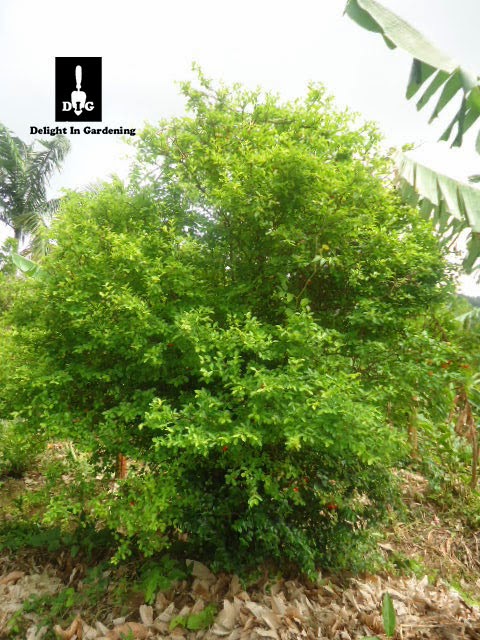
West Indian cherry tree. Cherries are hiding in there.
Additional Source:

If you found this post interesting, visit the links below:

Wednesday, June 25

Fruit Feature: Canistel


In this account of agventures (adVENTURES in AGgriculture), I can provide no justifiable explanation why this my first encounter with this fruit. I have never seen it sold in local farmers' market. Sadly, this is not a familiar fixture of home gardens. Maybe, others are in the same predicament as I: clueless about canistel.


Almost ripe canistel

A fruit is often imagined to be dripping of nature's nectar. But the canistel, like this source describes, is a "powdery" fruit. The green fruit ripens to yellow skin and yellow insides. Inside the flesh of the fruit are large, shiny brown seeds enclosed in what I can only describe as a fruity "plastic" casing. The texture of the fruit  pulp which is described as similar to a hard boiled egg has gained it the name Egg Fruit. This name may also be attributed to the colour of the insides and shape of the fruit itself. 


The delicious insides

Green canistel


First impresssions of Canistel

  • Sweet! Very sweet. It tastes like apricot with a subtle undertone of sugar apple. No sooner had I completed the staging of the open canistel, when an ant came to the picnic by way of agreement.
  • The texture of the fruit is like cooked sweet potatoes (another reference to the sweet taste). It's like a slice of cake...It's like desert and food in one!
  • The scent, a heady pungence that I liken to that of apricot also. Before the fruit even forms, the scent of the flowers attract bees to the tree.


Although I have been told that the fruit is made into delicious drinks, a Google search will produce recipe results  such as ice-creams and pies. Nutritional value of canistel includes dietary fibre, carbohydrates, niacin, carotene, ascorbic acid, calcium and phosphorus.

Canistel flowers

Are you convinced yet that you should have this fruit tree in your yard? Propagated canistel plants can be sourced at the Barthe Propagation Station at Myers Bridge, Soufriere.

Additional sources:

Tuesday, March 18

A Lesson in Grafting

Generally, flowering trees reproduce by seed. However, when flowers are cross-pollinated, the seed that develops in the fruit after fertilization contains genetic properties from two different plants. Therefore, the tree that develops when the new tree develops will not exhibit the same traits as the parent plant. Grafting provides a solution to the dilemma of how to get the exact tastiness, texture, firmness and other preferred traits replicated for future enjoyment. As you can imagine, grafted plants are the choice of the farmers.

Today I am fortunate to witness, refresh and broaden my knowledge on the process of grafting fruit trees. The subjects today are cocoa trees. 

1. The scion selections are prepared: The top is wrapped with a strip of plastic; The end to be fitted into the stock is trimmed into a wedge shape. It is important that the scion must be about the same size of the stock: not too big and not smaller.

Skilled hands

 2. Stocks are neatly cut off.


 3. A cleft is made down the middle of the stock.


4. The scions are inserted into the stock


5. The graft union is securely wrapped with another strip of plastic. This is meant to prevent water entry and prevent the growth of fungus. The new growth of the graft will gradually stretch and break through the plastic strips.

The finished product!
It is an optional step to spray around the completed graft union with the fungicide, Kocide for added measure. Growth progress is checked in fifteen (15) days.

Other tree crops which are propagated by the grafting method are mangoes and citrus.

Additional Source: 
http://www.extension.umn.edu/garden/yard-garden/fruit/grafting-and-budding-fruit-trees/

Sunday, March 9

A Berry Good Time

Once upon a time...

Those classical words draw us into storybook adventures of characters in a time long, long ago in settings that are out of this world. The adventure that is my life began in a rural community. In younger days my cousin, sister and I would accompany our grandfather to the "Countyside"-a place more agriculturally prime than the rural community where we resided, a place of rocky uphill footpaths which were inaccessible by motor vehicles. Thus, the trip there was by foot. The hour-long walk required starting before dawn. The early morning coolness made the distance more tolerable. All good tales are marked by journeys; even more so the ones that take place in the half light.

One of the unique features of this trip was the berries that grew in the "Countryside". They flourish in the lower temperatures at this high altitude. "Brambles" is a very English word that I first encountered in childhood books by Enid Blyton. These berries grew on prickly, wildly growing bushes. 


Saint Lucia's Wild Raspberry


These berries are called Wild Raspberries (Scientific Name: Rubus idaeus). Today the berries have a place on the "Fruits of Saint Lucia Chart" sponsored by First Citizens Investment Services. The initiative is a production of Nasser Khan for Trinidad and Tobago, but has been adapted for Saint Lucia. The chart was launched last year on January 29. According to the article:
"The initiative [...] aims to familiarise students and residents alike with the variety of local fruits, vegetables and herbs which are available on the island. This is in an effort to help foster consumption of locally grown foods and help reduce the country's food bill"
 As these berries are so tiny and so sensitive to the environment, I do not believe that they strong candidates for food security. But they are excellent for biodiversity and should be conserved as an indigenous Saint Lucian plant.

The berries were photographed at Deraches, Fond St. Jacques, Soufriere.

Saturday, February 15

THE FAMILIAR AND UNFAMILIAR (3)

"Food is our common ground,
a universal experience."
~James Beard


Did you ever wonder at the identity of the bright orange fruit featured on all Fruit Logistica promotional material? Before the event, I had not been exposed to even a photograph of it. On this basis, it classifies as an exotic fruit.
Standing poster/board

While being pervasive on event material, it proved more difficult to locate the actual fruit on the stands. After walking miles of hallway, I finally located them on the second day of the Fruit Logistica. They were laid out at the Santa Margarita stand. In good exhibition fashion they are displayed both whole and cut open. As attractively orange as the outside is, the inside is garishly green. I am not eager to taste this fruit. Maybe I might be so inclined if there was a stand which served recipes of the kiwano.

The Star of the Show


So what is this famous mystery? The name of this fruit is Kiwano. A google search produces other names by which this fruit is known: horned melon, jelly melon, hedged gourd and melano. The alias African horned cucumber attests to its origins and explains why the seeds seem familiar to those of cucumber (Cucumis sativus).


Another exotic fruit (in my books) presents itself. This discovery looks less intimidating and I am willing to taste test. What a coincidence that it too is orange and the name begins with the letter "K"- Kaki. I have found it in the Spain section where samples are being distributed. It is delicious! It also helps to know that this fruit is a powerhouse of nutritional benefits which includes Vitamin C-just like the kiwano.
Right side up-Samples of kaki
 On the promotional material given, it states that : "Due to its sweet flavour a lot of people think that kaki fruit is fattening , but the caloric value is not exceedingly high." No doubt this makes a great option for healthy food dieters- if you can get your hands on it.

Bottoms up-Kaki in display case
In general, the Fruit Logistica was an wholesome opportunity to broaden my fruit experiences with new perspectives gained on familiar fruit and discovering the unfamiliar.

Please note that for additional photo moments of the Fruit Logistica, you can visit the D.I.G Facebook Page album

Additional resources: 

Sunday, February 9

THE FAMILIAR AND UNFAMILIAR (2)

Within the category of familiar fruits seen at the Fruit Logistica, it was interesting to encounter new varieties and value added products. One such example was mangoes. A wide range of African mangoes were exhibited namely: Palmer, Amelie, Smith, Keitt and Kent.

Mango Palmer at the Fruit Logistica

It has been lamented for years that during the mango season in Saint Lucia, much of the produce is wasted due to a lack in processing options. Dried mango snacks is one such option featured at the event. I had the opportunity to taste two brands:  7 Days Dried Mango from Pakistan made with Chaunsa mangoes; and Mama's Flavour from Tanzania. 
Mama's Flavour wins the taste test. My opinion was supported by my colleagues Additionally, they are solar dried and contain no additional ingredients. Other dried products include bananas, paw paw and pineapple.

Product of Pakistan

Product of Tanzania


Other dried mango snacks available were Bomarts Dried Mango from Ghana and SFA Premium Dried Mangoes from Pakistan.

Product of Ghana

Product of Pakistan

Before venturing into the production in dried fruit snacks due research must inform the best variety for processing and consumer taste preference. It would also be advantageous to follow the example of Tanzania with solar dried fruit for cost effectiveness, sustainability and tastiness.

Please  note: Additional photo highlights of the Fruit Logistica can be found on the D.I.G Facebook page

THE FAMILIAR and UNFAMILIAR (1)

"A fruit is not afraid of its own weight.
It grows into its skin fully. It is whole,
each part of its body equally alive"
~Gayle Brandeis 


Can you relate to the experience of being lost? Imagine that this is your first time in Berlin and you become separated from your group of friends and/or family in the vast crowd. Imagine the sense of panic And then on rejoining the group, the immense of relief! While most of the fruits featured at the Fruit Logistica were not completely foreign to me, some were unfamiliar. Examples such as imported apples, strawberries, pears and plums can be found on supermarket shelves in Saint Lucia. Like unexpectedly meeting old friends in new places, it was even more amazing to encounter fruits that are grown in Saint Lucia. 

1. Sugar Apples

Imagine my pleasant surprise to come across sugar apples at the Pakistan stand! They were displayed on the counter among other fruits. Their whites smiled up at me and I smiled down at them as we have known each other from my childhood. Our love relationship started ever since I was old enough to eat foods with seeds. The Pakistanis call them custard apples, but sugar apple is more fitting. 
Sugar apple opened for display

2. Sapodillas

Another joy to behold was the sapodilla. "Sapotee", as it is called locally is another long time love. The insides are not as dark as those I have enjoyed, but I imagine that they taste just as sweet when they ripen.
Sapotee cut open for display

3. Bananas

I imagine that a ripe banana is a ray of sunshine in the breakfast menu of anyone who resides in Europe. Especially during autumn and winter with the bleak, cold weather. Bananas, both ripe and green, were displayed by several territories throughout the event.
Green bananas in packaging at the Ghana stand

4. Pomegranate

A recent trend in the food business is the promotion of nutritional foods. More specifically, a niche market has been created for products with antioxidant properties which are available at premium price. Pomegranate is one such example; it can be found in many products from food to cosmetics. Where was this wonder fruit before all the market visibility? "Ponm gwennad" as it is called locally, was available in our backyards for free. 

Ponm gwennad on display
Packaging of the pomn gwennad

5. Passion Fruit

Purple passion fruit is a major African export. They were prominently displayed on lighted signs and in the arrangements which graced the stands. The illuminated images effectively transported me to tropical conditions while onsite in cold Berlin. A cold glass of passion fruit juice can however be refreshing in any climate.
Sign at the Kenya stand

The magnitude of the Fruit Logistica event is unimaginable amazing! You need to experience it to believe it. As an advertisement  seen at one of the stands depicts, the experience can be described as being bathed in fruit. However, there is still capacity for new participants. Can you imagine that at Fruit Logistica 2015, Saint Lucia reserves a stand? Or even better, for the Caribbean to be represented in an entire section? We should definitely showcase our primary and value added agricultural products.
Fruit Logistica is like being bathed in food

Please  note: Additional photo highlights of the Fruit Logistica can be found on the D.I.G Facebook
page

Saturday, November 16

Papaya Production


What is your favourite fruit? Papaya (local name: Papay) is a worthy candidate. This tropical fruit is served most often as a breakfast fruit. With its high water content, the nutritional value of papaya includes the water-soluble vitamins A, C and E; mineral content and fibre.

Papaya estate
Today I visit a farm in papaya production at Marquis Estate and not a moment too soon. Farmer E. is getting ready to harvest. The trees are laden. This dwarf, yet high-yielding variety is called Red Lady. The plant is a self-pollinating variety that is noted for its resistance to the papaya ring spot disease.

However, they are not as resistant to Anthracnose and Bunchy top diseases which currently challenge papaya production in Saint Lucia. Anthracnose is caused by the fungus, Colletotrichum gloeosporioides. Initial symptoms  of this disease manifests itself as watersoaked, sunken spots on the fruit. As the fungus develops the coloration of the spots change from black, then pink, then brown. Eventually, the flesh becomes soggy and spreads to the entire fruit. Anthracnose affects fruit both in the field and post-harvest.

Anthracnose on ripe fruit
Advanced stage of fruit rot


While Bunchy top is a transmitted by a leaf hopper, a1993 IICA Production asserts that the Bunchy Top is triggered by mineral deficiencies, the disease source being mycoplasma ."Bunchy top can be distinguished from boron deficiency by the fact that the tops of affected plants do not ooze latex when pricked". 
Both these diseases are controllable.


Bunch top advanced stage
Farmer E. believes that both the quality and quantity of papaya production establish papaya worthy not only at the breakfast table but also at the trade table to supersede banana production. While attempts have been made, papaya production has not significantly developed since historical 1993. The same diseases which plagued sustainable production and supply still exist. Commercial production was and still remains limited to the local market. The control of these debilitating diseases is a pre-requisite for the development of a papaya industry with export quantities and quality for international markets. It is also important to invest in research for the development of varieties that are resistant to disease. The Caribbean's competitive advantage over producers in sub-tropical areas also lies in:
  • Shorter time required to flower
  • Reduced period for fruit set
  • Reduced time to harvest

Please share your thoughts on the potential of the marketability of papaya.

Other sources: 

Wednesday, October 16

The Jam Diaries-Golden Apple

It takes a community to make a pot of jam
'Tis the season of golden apples. The green fruit ripens into golden yellow and that is how the fruit got its name. That is my version of the golden apple story and I am sticking to it. Sticking to my fingers will be sugary brown golden apple jam. As I take stock of the ingredients, I realise that one key ingredient is missing-bwaden: one of the spices of life. A special effort is made with my home-made jams, since the commercial jams have a smaller spice content. I walk down the hillside, cross the river and up the slope to the neighbour's to get some leaves. Its time that I plant a tree near my home.
Fresh picked golden apples

Does size matter? 
Large product representations are often used in marketing to capture the interest of the consumer. For instance, cereal boxes advertise large flakes on the front of the package. Despite previous purchasing experience and the fine print disclaimer, we are hooked every time. Jam making is not an exception to the marketing rule. I opt for medium- to large-sized golden apples. This allows for losses in the cooking process as some of the golden apple will break down into the 'sauce'.

The sugar and spice and everything cooks nice
Golden apples are picked, washed and peeled. The coal pot is lit. I prefer cooking jams on charcoals. Some argue that anything cooked this way tastes better and its true. My other reasons are to save cooking gas and to keep the coal pot traditions alive. 
The spices of life
My select spices are cinnamon, bwaden and nutmeg (both the nut and the dried mace). I have been saving up nutmeg mace since I learnt they are great in jams.The sugar and spice are boiled with water to reach a thick sticky consistency. It is important that there is not much liquid in the pot at this time. When the golden apples are added, they will simmer in their own juices.The fruit is added and the pot checked periodically to check the progress of the jam.


Red hot glowing coals

And the pot bubbles over


It takes a community to eat a pot of jam
The pot is off the coal pot and cooled. 
Golden apple-y Goodness
It is time to test my jam making skills. I think it tastes delicious but that is unconfirmed until I receive feed back from the community. I prepare small packages of jam for neighbours and friends. And before you know it there is no jam left. It is time to prepare another pot.

Monday, August 5

Love of Breadfruit

Butterflies on breadfruit

The breadfruit (local name: Bwapen) is a staple of the St. Lucian diet. Traditionally, hearty meals of roasted or boiled breadfruit with a choice of salted fish, roasted sardines or smoked herring were featured meals. With store branded starch products such as macaroni, spaghetti, and rice available on the market, persons have acquired new tastes. Culinary creativity has led to new recipes such as baked breadfruit pies which would appeal to the palate of the youth in particular. In recent discussions on food scarcity the breadfruit has been identified as one of the crops for food and nutrition security in the Caribbean. There has been a thrust to develop the breadfruit through the use of food technology. Breadfruit flour is an example of the value added products developed. The following are some reasons not to discount the breadfruit:

The breadfruit is an essential part of a healthy diet as rich source of dietary fibre. Fibre is required by the body for various functions. It regulates the  movement of the gastrointestinal tract. The carbohydrate content of breadfruit provides energy. In medical studies, fibre has been linked to decreased risk of heart attacks by lowering bad cholesterol levels in the body while increasing good cholesterol levels in the body.

Breadfruit also protects against against heart disease as it is a good source of Vitamin C. The benefits of this vitamin in maintaining the immune system is especially appreciated when one has a cold/flu. Vitamin C is also known for its antioxidant properties, blocking the damage caused by free radicals. The accumulation of free radicals in the body have been linked to the aging process and non-communicable health conditions such as cancer and heart disease.
Further, breadfruit also contains B-complex vitamins which contribute to general good health. The B vitamins aid in assisting the energy from the food we eat, generates new cells and maintains a healthy immune and nervous system. Omega-3 and Omega-6 fatty acids found in breadfruits also contribute to all round good health.
Potassium, iron and phosphorus are other mineral constituents of breadfruit of nutritional value. 

At present the sale price of breadfruit at the Castries market is $5/breadfruit. If you have a breadfruit tree in your yard then you are at an advantage. 

It is important to consume locally produced food crops like breadfruit, reducing our food import bill and improving the livelihoods of local farmers. Endure the added preparation time; take time to be healthy.

Here are a few additional resources for addtional nutritional value of the breadfruit:

Sunday, July 28

THIS HARD GUAVA SEASON


In St. Lucian parlance, the phrase “hard guava season” refers to a period of financial difficulty. Despite some guavas being sour, the taste of deliciously sweet guavas is not too hard to stomach. Quite by chance I discovered a source for my favorite variety of guavas- large, yellow on the outside and white on the inside. Part of the Taiwanese Technical Mission in St. Lucia includes the model farming of this guava variety and the propagation of the plants for sale. The guavas themselves although previously available for commercial sale, are no longer available on the market. However, having invested time and interest in visiting the model farm, you may be obliged a few.


The most interesting farming practice noted on the farm was the use of fruit covers made of a styrofoam material. These are slipped on the fruit while it is still growing on the tree to deter birds and insect pests. As an additional precaution, a clear plastic bag is placed over the styrofoam sleeve. Decidedly, this was a best practice for home gardening of tomatoes and sweet peppers where greenhouse cover is not applicable. The sleeves off the gifted fruits were recycled in my own backyard project. Calls to input to input suppliers to source this product yielded no results. I took the search to the internet. Availability was limited to wholesale quantities which is not cost effective for small-scale home gardening.

On a subsequent visit, I patronized the facility through the purchase of one plant. The sale price was ten dollars. Assisted by a very enthusiastic employee, I was sold a plant that had already two green fruit. I was informed that initially the size of the fruit will not match that I had seen on the model farm. They would gradually grow in size over the years. The only difficulty I foresee is patience in waiting the harvest of guavas the size of coconuts.